When you open a case with Dell EMC storage support (VNX, Unity, PowerMax/VMAX, XtremIO and others), one of the first things they ask for is an EMC Grab from the ESXi hosts attached to the array. EMC Grab collects host, HBA, multipathing and network configuration in a single bundle. The Windows client version runs from your admin workstation and connects to each host over SSH, so you don't need to install anything on ESXi.
Applies to: ESXi 6.x – 8.x hosts attached to Dell EMC storage, collected from a Windows admin workstation.
Before you start
- Get the current EMC Grab for ESXi (Windows client). The old
ftp.emc.comdownload location from the original version of this post no longer works. EMC Grab is now distributed through Dell Support (search for EMC Grab on dell.com/support; a Dell Support account may be required). If you have an open case, the support engineer can send you the current build. - Temporarily enable SSH on the host. If it won't connect, see unable to connect to ESXi using SSH.
- Have the host's root password (or another account with shell access) ready.
Step 1: Extract the files
Unzip the download, for example to C:\EMCGRAB.
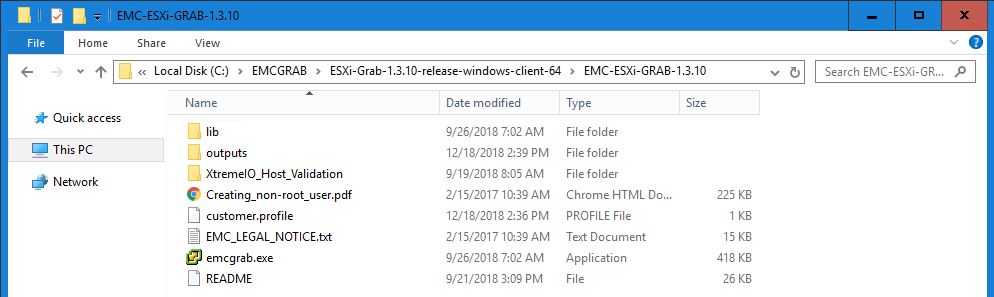
Step 2: Open an elevated Command Prompt in the tool's folder
cd "C:\EMCGRAB\ESXi-Grab-1.3.10-release-windows-client-64\EMC-ESXi-GRAB-1.3.10"
Adjust the folder name to match the version you downloaded.
Step 3: Run EMC Grab against the host
emcgrab -host 10.10.x.x -user root -password -vmsupport
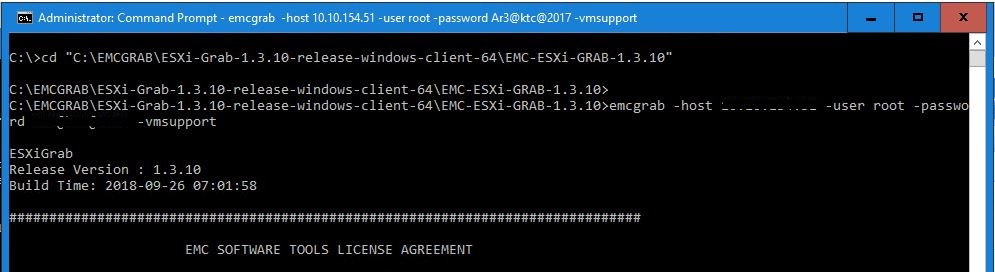
-passwordwithout a value makes the tool prompt for the password, so it isn't saved in your command history.-vmsupportalso collects a VMwarevm-supportbundle. Support usually wants it, but it makes the run longer and the output much bigger.- Add
-outdir C:\EMCGRAB\Outputto choose where the result is saved.
Step 4: Answer the prompts
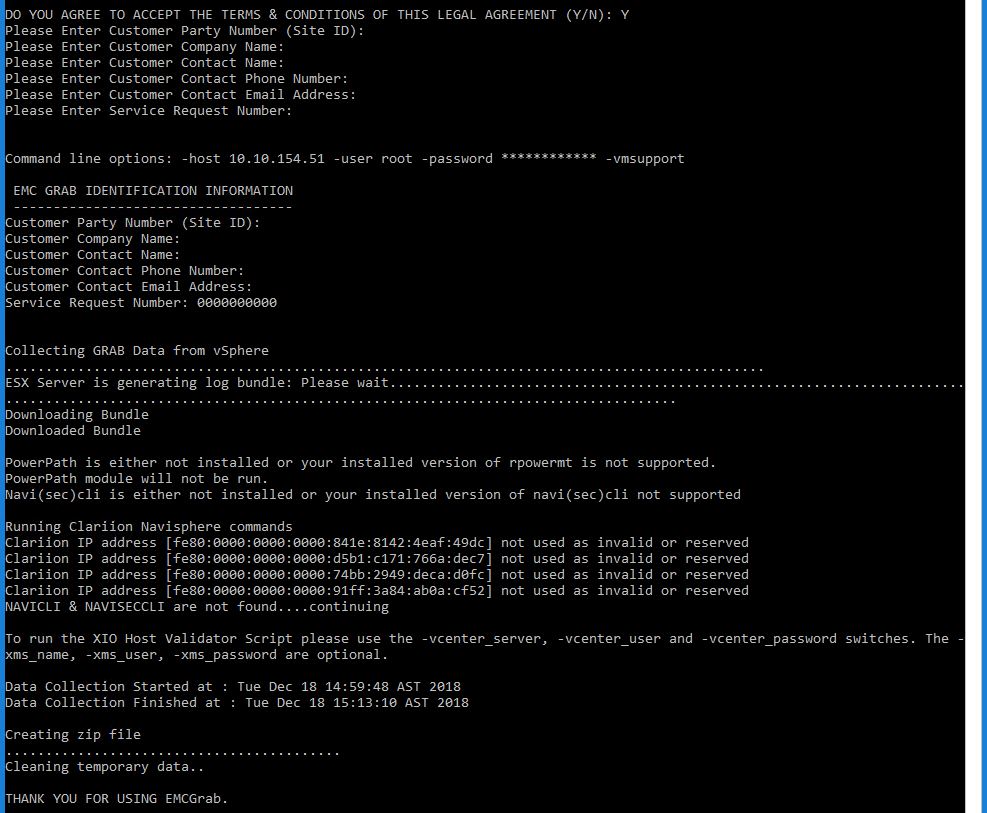
The tool asks for optional details such as case number, company and contact. Press Enter to skip any of them.
Step 5: Collect the output and upload it
When the run finishes, the bundle is in the output folder (or your -outdir). Upload it to the support case.

Step 6: Disable SSH again
Stop the SSH service on the host when you're finished. Leaving it running is a security risk, and vSphere raises a warning while it's on.
Collecting from several hosts
Run the command once per host, using a separate -outdir for each so the bundles don't mix:
for %h in (10.10.1.11 10.10.1.12 10.10.1.13) do emcgrab -host %h -user root -password -vmsupport -outdir C:\EMCGRAB\Output\%h
(Use %%h instead of %h inside a .cmd batch file.) The tool prompts for each host's password in turn.
If support only needs VMware logs
If the case is purely on the VMware side, a standard log bundle is enough. Generate it from the vSphere Client → host → Export System Logs, or run vm-support in the ESXi Shell.
Related: Find WWN / WWPN in Windows Server with PowerShell · Finding VMs with a fixed or round-robin multipath policy · Unable to connect to ESXi using SSH